Habit Tracking: The Complete Guide (2026)
An evidence-based guide to habit tracking: what to track, which schedules match real life, how to handle missed days and vacations without guilt — and how to build a system you will actually keep.
Habit tracking is the practice of recording whether you did the things you intended to do — and it is one of the most reliably effective behavior-change techniques in psychology. This guide covers the whole system: what to track, how often, which formats fit which behavior, what to do when you miss, and how to keep the whole thing lightweight enough to survive real life.
The short version: pick one to three specific behaviors, define what counts as done before the day begins, put the tracker where you will actually see it, review the record weekly, and treat missed days as data rather than failure. Everything below is the detail behind those five sentences.
Why tracking works
Tracking is a form of self-monitoring. A 2016 meta-analysis of 138 studies covering nearly 20,000 participants found that people who monitor their progress toward goals are significantly more likely to reach them — the effect holds across health, academic, and work settings. The mechanism is not magic: a record makes progress visible, turns intentions into concrete daily decisions, and gives you feedback about whether the plan actually fits your life.
It is worth being precise about what a tracker can and cannot do. It helps you remember, shows patterns you would otherwise guess at, and keeps a busy week from quietly erasing your commitments. It cannot make a badly defined habit succeed: if the behavior is vague or the schedule punishes normal life, tracking just documents the frustration. That is why most of this guide is about what happens before the checkmark.
What to track: behaviors, not outcomes
A trackable habit has four parts: a behavior you control, a rule that defines done, a schedule of real opportunities, and a record. The behavior should be observable — "do 20 minutes of exercise," not "get fit." Outcomes like losing weight or feeling less stressed are goals; the habits are the actions that move you toward them.
Start with one to three habits, not ten. Every tracked habit is really two habits: the behavior itself and the habit of tracking it. James Clear's advice is to shrink habits until they take two minutes or less on a bad day — one page, one push-up, one sentence in a journal — and let the record grow the habit from there. Write each habit so a stranger could verify it: specific action, clear threshold, no judgment calls at bedtime.
Choosing your tracking method
Every method works if you use it; they differ in friction, memory, and how much system you want to build. Here is the honest comparison:
| Aspect | Paper | Spreadsheet | App |
|---|---|---|---|
| Logging friction | Low — a pen and a glance, if the journal is visible | High on mobile — editing cells on a phone is tedious | Lowest — one tap from home screen or widget |
| Reminders | None — placement does the work | Manual calendar nudges | Per-habit notifications on the right days |
| Flexible schedules | Manual — easy to drift | Possible with formulas, easy to break | Built in: weekdays, intervals, weekly targets |
| History and stats | Visual only — flipping pages | Powerful if you maintain it | Heatmaps, completion rates, streaks automatically |
| Privacy and offline | Fully private, fully offline | Depends on where the file lives | Varies — check for accounts, ads, and cloud defaults |
| Best for | One to three stable daily habits | Data lovers with custom metrics | Mixed routines, irregular schedules, growth |
If you are unsure where to start, pick the method you are most likely to still use in three months. Paper suits stable routines; spreadsheets suit people who already live in them; apps solve the two problems that sink most tracking attempts — forgetting to log, and schedules that do not match real life. For a deeper honest breakdown of what "free" means in habit apps, see our guide to the best free habit trackers.
Schedules that match real life
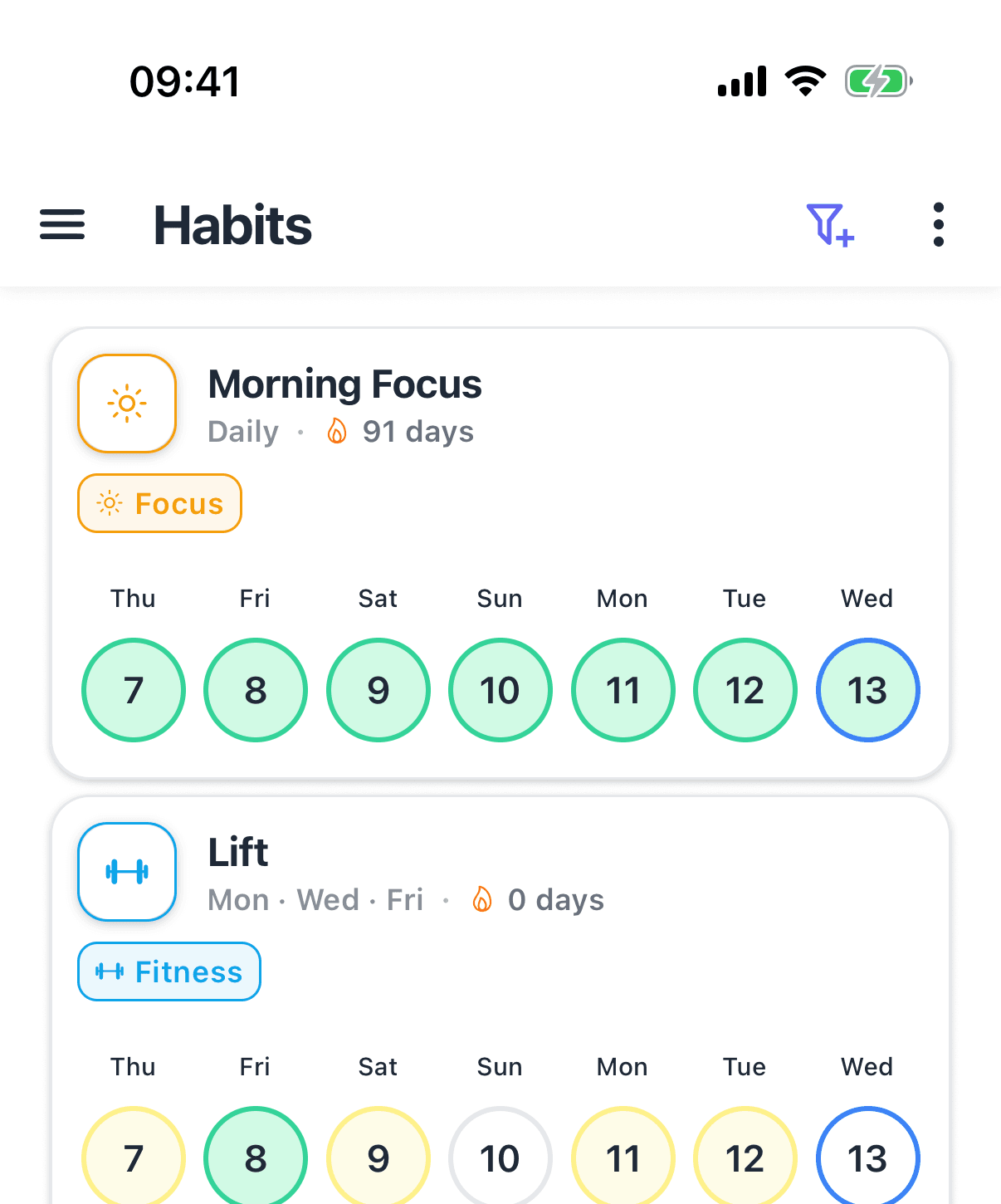
The single most common tracking failure is a schedule that lies: a habit that really happens three times a week is configured for seven days, and four days a week show up as misses. That is not a discipline problem — the tracker is misconfigured. Tuesday is not a missed day for a Monday-Wednesday-Friday gym routine; it was never scheduled.
Match the schedule to the behavior: specific weekdays for things tied to work or class rhythms; every-N-day rhythms for things like strength training with rest days; flexible weekly targets — three times a week, any days — for behaviors that should happen but should not dictate which days; and ordinal schedules ("every 3rd occurrence") for habits that follow events rather than dates. Our guide to gym consistency shows how this plays out for training, and rebuilding a routine after a break covers restarting honestly when schedules fall apart.
Formats: match the measurement to the habit
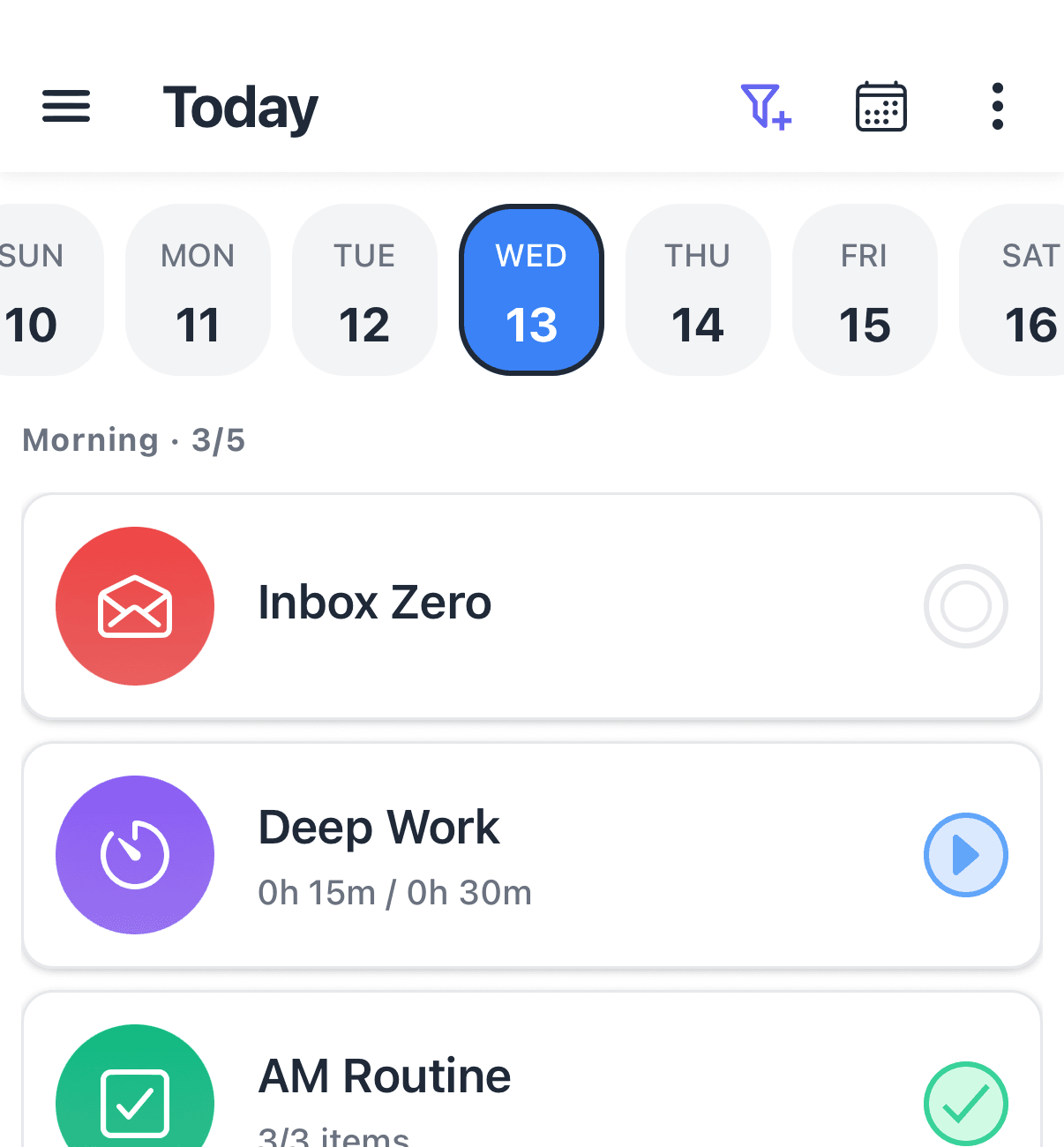
A yes/no checkmark is not the only unit of habit tracking — and for many behaviors it is the wrong one. Four formats cover almost everything: yes/no for binary behaviors (floss, meditate, make the bed); numeric targets for counts with a threshold (8,000 steps, 2 liters of water, at most 2 coffees); timer habits for duration (25 focused minutes, 15 minutes of reading); and checklists for multi-step routines where the whole sequence is the habit.
The format should make the record honest. A numeric habit logged as yes/no hides how close you got; a checklist collapsed to a single checkmark hides which step always gets skipped. If you want to see how the formats work in practice, our beginner's guide to HabitGrip walks through setting each of them up.
Cues and stacking: when the habit happens
A habit needs a cue — a time, place, or preceding action that reliably tells you it is available. The most dependable cues are action-based: "after I pour my morning coffee, I journal for five minutes." This is habit stacking, and it is more than a productivity trick — it is the difference between remembering sometimes and remembering almost always.
Implementation intentions help here too: writing "when X, I will Y" measurably increases follow-through compared with vague intentions. If you want ready-made stacks, our collection of 25 habit stacking examples covers morning, work, and evening routines, and the four laws from Atomic Habits map each law to concrete tracker settings.
The daily check-in and the weekly review
Log at the moment the habit happens — or within a few minutes — while memory is fresh. End-of-day logging works for a few habits, but it turns into reconstruction, and reconstruction drifts optimistic. Logging should take seconds; if it takes effort, reduce the system rather than push harder.
The review is what turns a record into a system. Once a week, spend ten minutes on four questions: What was completed as planned? What was missed — and what made it hard? Is the threshold still realistic on an ordinary day? And is each habit still worth its place? Change one variable at a time — the cue, the schedule, or the threshold — so next week tells you what worked. A record you never review is just decoration.
Handling breaks without breaking the system
Every tracking streak ends eventually — vacations, illness, deadlines, family. What happens next depends entirely on how the system treats the gap. The research is reassuring: Lally's UCL team found that missing a single day did not materially affect habit formation. The danger is not the missed day; it is the spiral of guilt and avoidance that follows it.
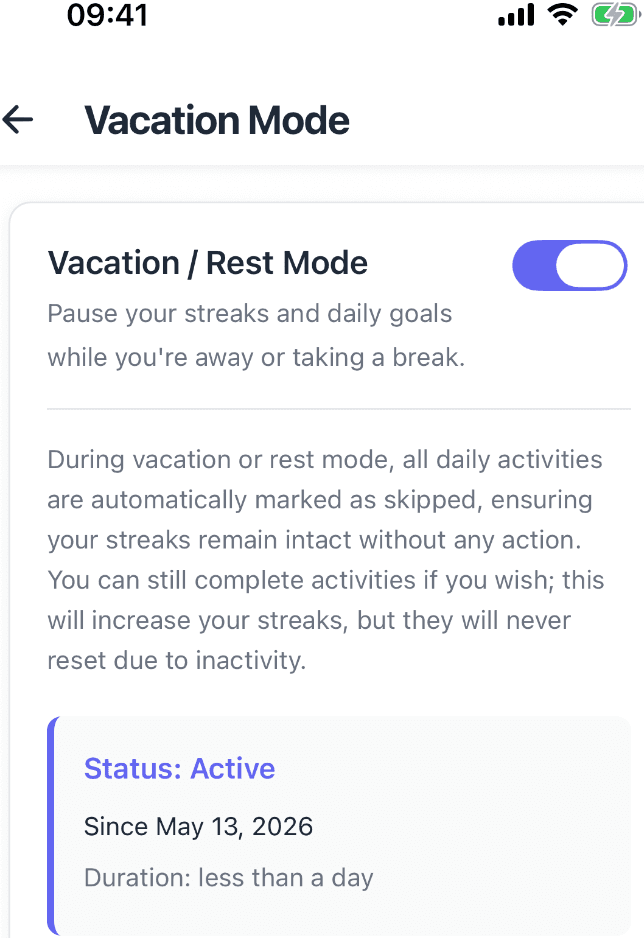
Two mechanisms keep a break small. First, record the day honestly — most systems allow done, skipped, and failed, and the difference matters: skipped is a decision, failed is a slip, and both are data. Second, protect planned breaks. A good tracker lets you pause habits for a vacation without the pause counting as missed days, which is exactly what tracking without streak anxiety looks like in practice.
Visibility: put the tracker where your eyes are
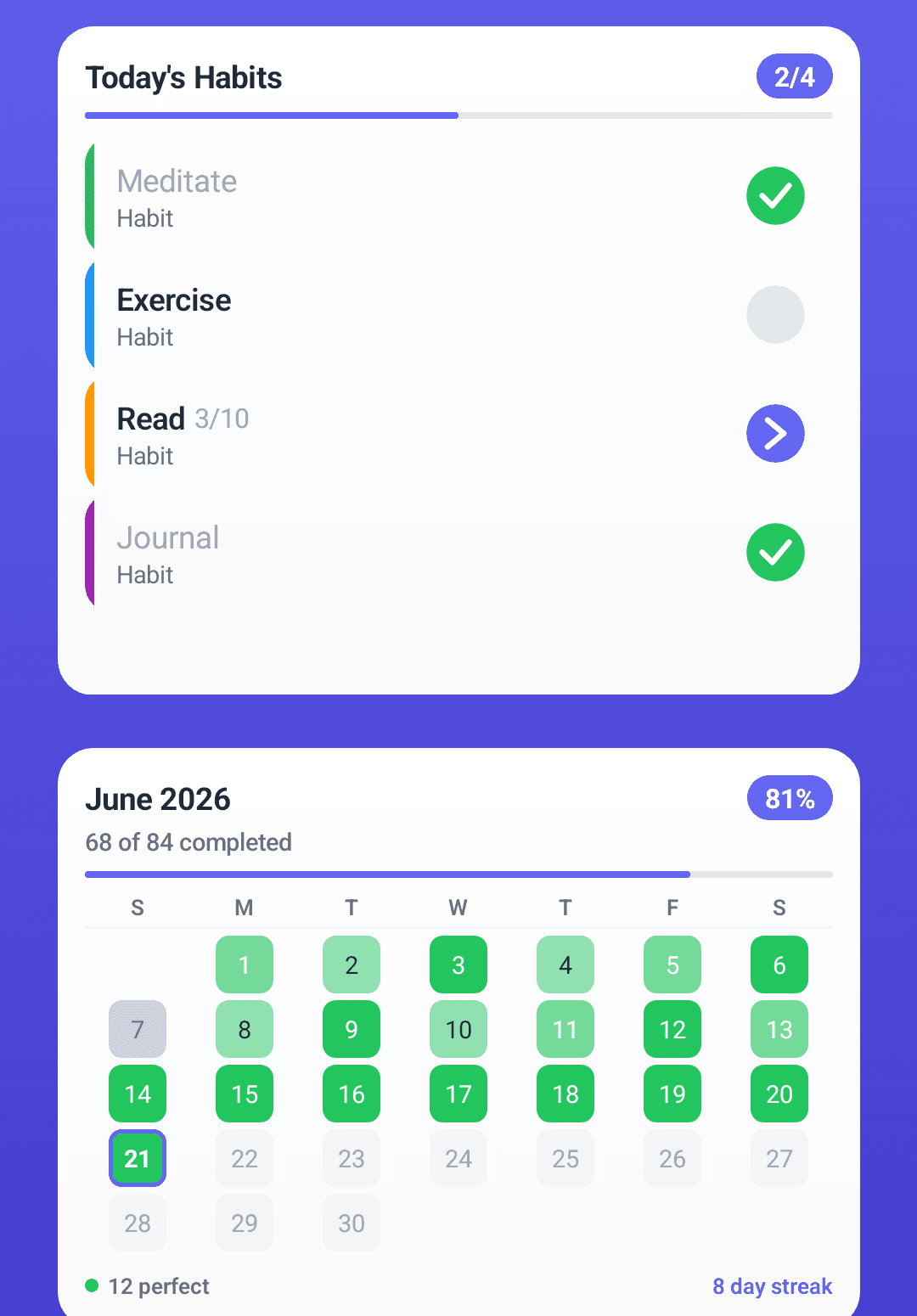
Placement beats motivation. Paper journals work on the pillow or next to the coffee maker; apps work when checking off is one glance away — which is what home-screen widgets are for. A widget removes the app-opening friction that kills evening check-ins, and a monthly heatmap makes the "never miss twice" decision visible before it becomes a spiral. Our guide to habit tracker widgets on Android covers which layouts actually help.
Choosing an app (if you choose one)
If you go the app route, judge tools on the things this guide treats as load-bearing: flexible schedules that match the behavior, honest states for skipped days, planned-break support, four tracking formats, widgets for visibility, and data you control — local-first storage, exports, and no account required unless you ask for one. Ads, guilt mechanics, and features locked behind surprise subscriptions are the usual failure modes.
For a market overview rather than one-by-one comparisons, our ranked guide to the best habit trackers of 2026 covers eight apps by use case — Loop, HabitKit, Atoms, Fabulous, Habitica, Habitify, HabitNow, and HabitGrip itself, each judged with its shortfalls included.
Because we built HabitGrip around exactly these principles, we have written honest comparisons so you can decide for yourself: vs. Loop Habit Tracker, vs. Habitica, and vs. Fabulous. And if you want the backstory rather than the spec sheet, why we built HabitGrip after failing with seven other apps explains the philosophy — HabitGrip itself is on Google Play for Android.
Switching apps without losing your history
If you already track habits elsewhere, your completion history is worth keeping — heatmaps and stats only become meaningful with months of data. We maintain step-by-step migration guides for Habitify, Habit Bull, Productive, HabitNow, and a comparison covering Loop's CSV import — each includes verification steps and parallel-run advice.
Finally, match the system to the person. Our ADHD guide covers low-friction setups and rigid-schedule workarounds, the student guide builds tracking around the semester instead of the calendar year, and the burnout guide shows what tracking looks like when energy — not time — is the constraint, and the developer guide schedules keystones around sprints, on-call weeks, and the Mon–Fri reality of engineering work.
Frequently asked questions
How many habits should I track at once?
Start with one to three new habits. Tracking more than that at the start creates checklist fatigue, and the habits themselves suffer. Add the next habit only when the current ones feel automatic — research suggests that takes around 66 days on average, though it varies widely by behavior.
Is a paper tracker or a habit app better?
Paper is fast, private, and free — and works well for one to three habits you check in a fixed place. Apps add reminders, flexible schedules, statistics, and widgets, which matter once your system grows or your routines are irregular. The honest rule: the best method is the one you will still be using in three months.
How long does it take to form a habit?
A University College London study led by Phillippa Lally found habits take about 66 days on average to become automatic, with a range from 18 to 254 days depending on the behavior. Importantly, missing a single day did not measurably derail habit formation — consistency over months matters more than any individual day.
What should I do when I miss a day?
Record it honestly and continue the next day. James Clear's 'never miss twice' rule is the practical version: one miss is an accident, two in a row is the start of a new habit of not doing it. A tracker that records misses without extra punishment — rather than one that shames you — makes honest logging easier.
Do streaks actually work?
Streaks create momentum, and many people find them motivating — until a planned break or sick week resets the counter and the motivation collapses with it. Streaks work best as one signal among several: completion rate over months, your actual schedule, and how quickly you return after a miss all matter more than a consecutive-day count.
Sources
- Harkin et al. (2016): The effects of progress monitoring on goal attainment — a meta-analysis
- Lally et al. (2010): How are habits formed — modelling habit formation in the real world
- BJ Fogg: Tiny Habits
- James Clear: The Ultimate Habit Tracker Guide
A system that survives real life
HabitGrip combines flexible habits, tasks, vacation mode, and optional sync while keeping offline tracking at the center.