The 8 Best Habit Trackers in 2026 (Ranked by Use Case)
The best habit tracker apps of 2026, ranked by use case instead of hype: Loop for free and open source, HabitKit for design, Atoms for Atomic Habits coaching, Fabulous for guided routines, Habitica for gamification, Habitify for cross-platform cloud, HabitNow for habits with tasks — plus an honest section on our own app and where it falls short.
The best habit tracker in 2026 is not one app — it is the app that matches what you are trying to do. A strict daily checklist, a flexible system that survives real weeks, a coach, a game, or a private tool that never phones home all need different designs. This list ranks eight trackers by use case, not by marketing spend.
Full disclosure up front: we build HabitGrip, and it is on this list. We judged it by the same criteria as everyone else and included an honest section on where it falls short, because a “best of” list written by an app developer that skips that part is advertising, not advice.
How we picked the best habit trackers
Every app below was screened against six criteria, the same ones we use across our comparisons:
- Scheduling flexibility.Real life is not a daily checkbox. Can the app say “three times a week”, “every other day”, or “weekdays only” without breaking the record?
- Honest records. A skipped day is information, not a sin. Apps that punish missed days look great in week one and feel like a debt collector by week six.
- Data portability. Can you get your history out? CSV export, backups, or imports — lock-in is the tax you pay later.
- Visibility. Widgets or shortcuts that keep habits in front of your eyes instead of buried behind a notification.
- Sustainable pricing. Free tiers that are real products, and prices that make sense against what you actually track.
- Privacy. At minimum, clarity about where your data lives — habit history reveals health, mood, and behavior patterns.
The 8 best habit trackers at a glance
| App | Platforms | Free tier | Paid | Best for |
|---|---|---|---|---|
| Loop Habit Tracker | Android | Everything — free and open source | None | Free, open-source tracking |
| HabitGrip | Android (iOS planned) | 5 habits, tasks, widgets included | One-time Pro; Ultra adds sync | Privacy-first, flexible tracking |
| HabitKit | Android, iOS | 4 habits, ad-free | Pro subscription or lifetime | Design and simplicity |
| Atoms | iOS, Android, macOS | 1 habit; full app for 28 days | Pro subscription | Atomic Habits coaching |
| Fabulous | Android, iOS | Basic habit and ritual tracking | Premium subscription | Guided routines and coaching |
| Habitica | Android, iOS, web | Core tracking with an account | Optional Plus subscription | Gamification |
| Habitify | Android, iOS, Mac, web, Wear OS | 3 habits with sync | Plus or Pro plans | Cross-platform cloud tracking |
| HabitNow | Android | About 7 habits and tasks combined | One-time premium | Habits plus deep task management |
Product details can change. The entries above are based on each app's official store listings, website, and help center as of publication (October 2026); pricing varies by platform, region, and store. HabitGrip entries reflect this site's current product information.
Best free and open-source habit tracker: Loop
If your main question is “what will this cost me, ever?”, Loop Habit Tracker is the answer. It is completely free, open source under GPLv3, and carries no ads, no in-app purchases, and no subscription — every feature is unlocked from day one. Around five million Android installs and a 4.7-star Play rating from tens of thousands of reviews make it the most trusted free tracker on the platform.
Loop keeps your data on your device, works fully offline, and needs no account. It handles yes/no habits and measurable ones, with a forgiving habit score — a few misses do not erase your progress. The trade-offs are the flip side of its simplicity: it is Android-only with no iPhone app, there is a streak reset after consecutive missed days, no vacation pause for planned breaks, and no cloud sync — backups are manual CSV or SQLite exports, so a lost phone without a backup means a lost history.
Loop is also the app most people eventually leave for one of three reasons — sync, backup, or a richer iPhone option — which we cover in our guide to Loop Habit Tracker alternatives.
Best for privacy-first tracking: HabitGrip
HabitGrip is for people who want the flexibility of a full habit system without an account, ads, or a cloud dependency. It is local-first: tracking works fully offline, your data stays on your device, and there are no ads and no account requirement. Optional cross-device sync exists for people who want it — but it is a choice, not a requirement.
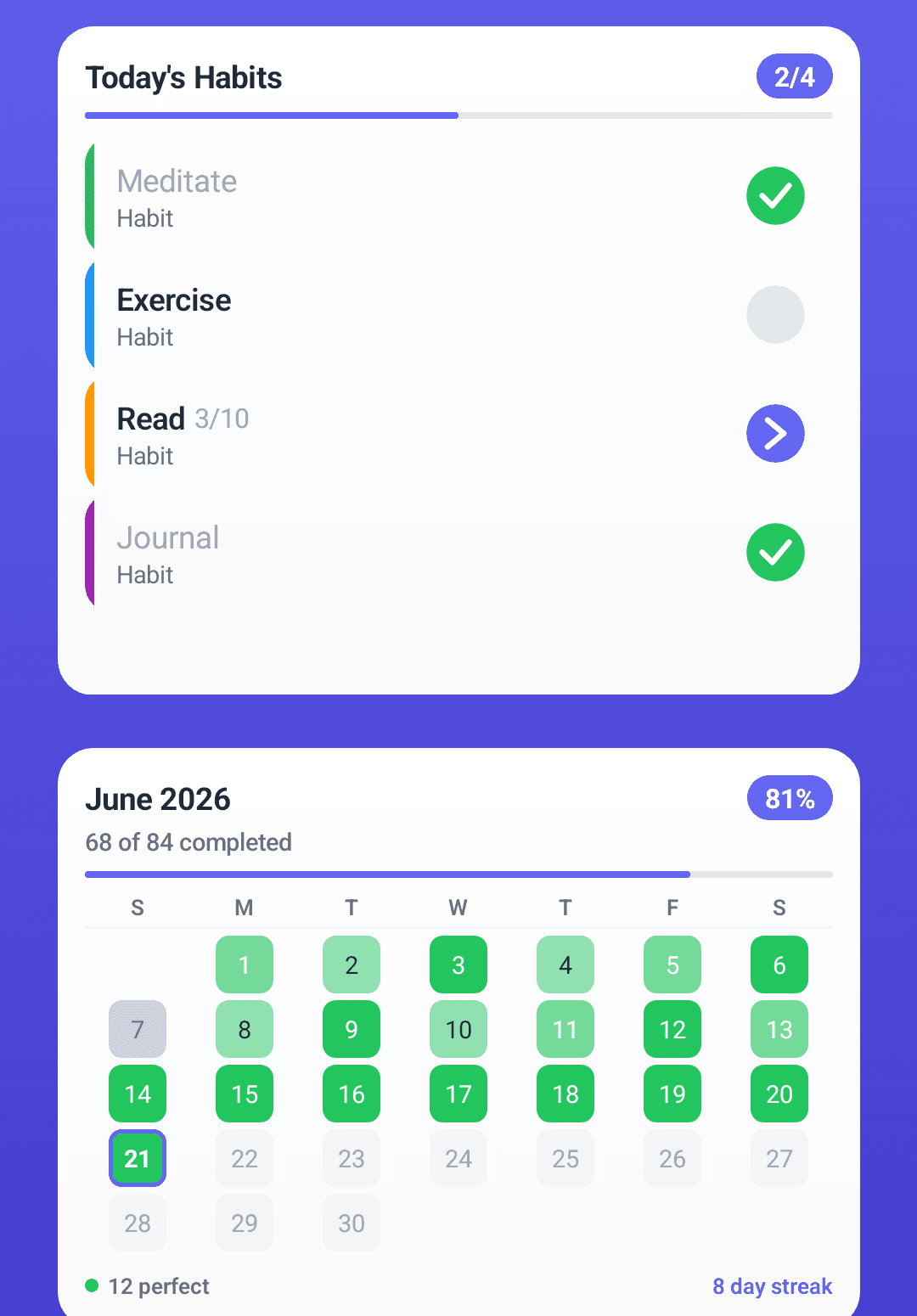
The tracking depth is the point. Four habit formats cover yes/no check-ins, numeric targets with at-least and at-most rules, timer sessions, and multi-step checklists. Schedules match real rhythms: specific weekdays, every-N-day intervals, ordinal dates, and flexible counts like “three times a week” without preselecting days. Done, skipped, and failed are separate record statuses, so an honest “not today” is not punished as a broken streak. One-off and recurring tasks share the Today view with habits, and eight home-screen widgets — today, streak, heatmap, momentum — keep progress visible without opening the app.
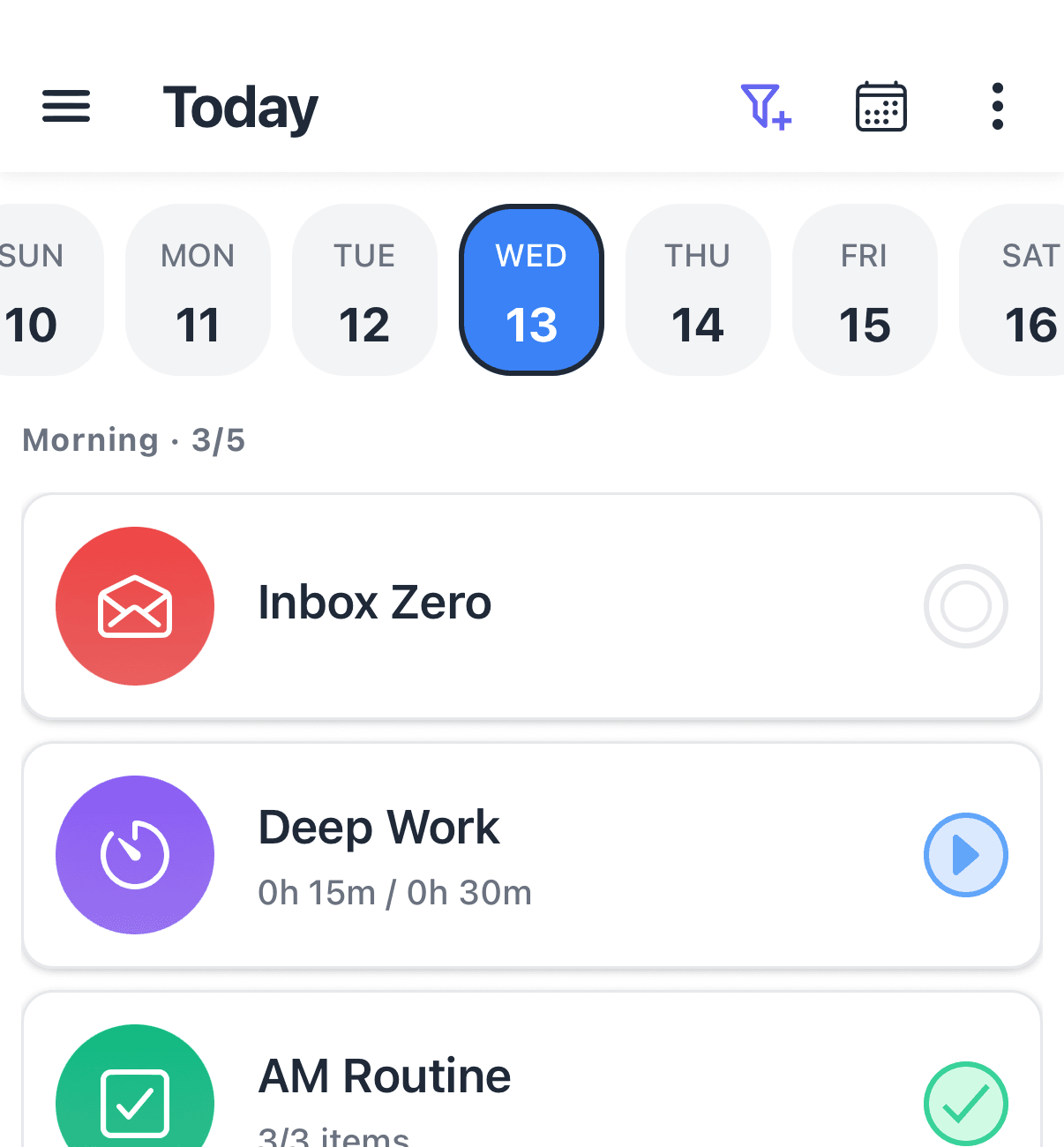
HabitGrip is Android-only today (iPhone and iPad are planned — there's a waitlist), the free tier covers five habits, and there are no integrations with Apple Health or Health Connect — if your habits live in workouts and sleep data logged elsewhere, that is a real gap. Our full feature rundown is in the beginner's guide to HabitGrip.
Best for design and simplicity: HabitKit
HabitKit wins on visual ritual. Each habit is a GitHub-style tile grid you fill in day by day, and the app has maintained a 4.6–4.8 rating across tens of thousands of store reviews on both Android and iOS — rare in this category. Built by solo developer Sebastian Röhl, it is ad-free, stores habit data on-device with no sign-in, and offers a lifetime purchase instead of renting the app forever.
The free tier covers up to four habits, and Pro — roughly $1.99 a month, $11.99 a year, or $29.99 once on the US stores, varying by region — removes the cap and unlocks statistics and widgets. The honest trade-offs: scheduling beyond daily ticks plus frequency goals (“3 times a week”) is not the tool's depth, there is no cloud sync or account — you move data by manual file export — and the Android widgets sit behind the Pro purchase. For a focused set of daily habits with a satisfying tap-a-tile loop, it is the best-looking option here. The full analysis is in our HabitGrip vs. HabitKit comparison.
Best for Atomic Habits fans: Atoms
Atoms is the official Atomic Habits app, designed with James Clear's team — and it treats habit building as coaching rather than logging. Onboarding walks you through the book's identity template (“I will [action] at [time and place] so I can become the type of person who…”), daily lessons keep the philosophy in front of you, and check-ins are framed as “votes” for the person you are becoming. The app shipped on iOS and Android together, with macOS and an Apple Watch app alongside.
The deliberate restraint — one habit on the free tier, six on Pro, a full 28-day trial before paying — matches the book's “start small” promise. But it is the most expensive option here: Atoms Pro is a subscription, with the US App Store listing $4.99 a month and $39.99 a year and higher tiers on other storefronts. If you already know which habits you want and just need honest tracking, the coaching is overhead. We compare the two philosophies in HabitGrip vs. Atoms, and our guide to the 4 Laws in a plain habit tracker applies the book's system without any app at all.
Best for guided routines: Fabulous
Fabulous is the deepest coaching platform on this list. Instead of isolated checkboxes, habits live inside morning, afternoon, and night rituals, and “journeys” guide you through named programs like better sleep or calmer mornings, built on behavioral-science principles. There are live challenges and a member community for accountability — structure that no plain tracker provides.
The free tier covers basic habit and ritual tracking, and Premium — roughly $40–60 a year at list price, with frequent intro offers — unlocks unlimited habits, the coaching series, and cloud backup. Two things to weigh honestly: it is account-based, with the Play data-safety label listing personal-info collection, and there is no self-serve export — requesting a copy of your app data goes through in-app support, with the help center citing around ten days to fulfill. If you want a program rather than a tool, Fabulous delivers that program; if you outgrow it, plan for a manual rebuild. The long form is in our HabitGrip vs. Fabulous comparison.
Best for gamification: Habitica
Habitica turns your life into a retro RPG, and for a certain kind of person that is simply the best motivation system available. Your avatar levels up as you check things off, you earn gold and buy gear, you feed pets, and — crucially — missing your dailies costs health points. Parties and guilds let you take on challenges and boss battles with friends, and peer accountability is built into the game itself.
The core mechanics are free with an account: unlimited habits, dailies, and to-dos across Android, iOS, and the web, plus home-screen widgets and a Wear OS app. The optional Plus subscription (about $4.99 a month or $47.99 a year) mostly buys cosmetics and extras that support development. The costs are structural rather than financial: it is cloud-based — your tasks live on Habitica's servers, with company statements that data stays private and is not sold — and the HP mechanic is exactly the streak-guilt model that burns some people out. If boss-battle pressure motivates you, nothing else here is close; if missed days already sting, read this list alongside our guide to tracking habits without streaks. Full comparison: HabitGrip vs. Habitica.
Best for cross-platform cloud tracking: Habitify
Habitify is the strongest pick if your habits span devices. It runs on Android, iPhone, Mac, the web, and Wear OS, with real-time account sync across all of them — start typing on your phone, review the week from your laptop. The design is clean and dashboard-like, with streaks, completion rates, charts, and heatmaps for each habit, plus smart extras like habit stacking (the next habit cues automatically when one check-in completes), a focus timer, and integrations with Google Calendar, Google Fit, and Strava.
The free plan covers up to 3 habits and one reminder per habit, with cross-platform sync included even on the free tier. As of the April 2026 pricing change, Habitify Plus — about $29.99 a year — removes the limits on habits, reminders, and areas, while Habitify Pro (with monthly, annual, and a $59.99 lifetime option) adds checklists, automation via API and Zapier, health integrations like Apple Health, and advanced timers. The structural trade-off is that everything is account-based cloud storage, and your history is managed on Habitify's servers — mindful of that, we wrote a step-by-step guide to exporting your Habitify data into HabitGrip if you ever change your mind.
Best for habits with deep task management: HabitNow
HabitNow is the power option for people whose habits and to-dos refuse to live in separate apps. It fuses both into one Android-native system: recurring tasks, routines, calendar views, priorities, categories, flexible daily/weekly/monthly goals, stopwatch and interval timers, and some of the most configurable reminders and alarms in the category — the reason many people pick it. A 4.7-star rating across more than 90,000 Play reviews and five million installs back up the quality.
The free tier caps at about seven habits and tasks combined, and the one-time premium upgrade (around $12, varying by region) unlocks the rest — cheaper than most subscriptions here. Backups are manual exports, with optional (premium) cloud backup if you connect a Google account. The trade-offs: it is Android-only, data stays in local backups rather than self-serve sync, and the streak mechanics lean demanding — check our guide to tracking without streak guilt if the pressure model matters to you. We walked through the full switch in our step-by-step HabitNow migration guide.
Where HabitGrip falls short — honestly
Because we make one of these apps, here is what our own six criteria say about us. HabitGrip is Android-only today — iPhone and iPad are planned, but today it is the wrong choice for a two-platform household. The free tier covers five habits, which is generous by freemium standards (Atoms gives you one, Habitify three, HabitKit four) but a real cap if you track a dozen. There are no health-app integrations, no social or community features, and no coaching — it assumes you already know the habits you want and gives you an instrument, not a program. If an open-source codebase matters to you on principle, Loop is the pick, not us.
What you get in exchange: four habit formats, schedules that flex to real weeks, tasks that live beside habits, vacation mode that pauses streaks without breaking them, eight widgets on the free tier, and a privacy posture you can verify — no account, no ads, local-first, opt-in analytics with no habit data. Pro is a one-time purchase, not a subscription tax.
Which habit tracker should you pick?
The fast version, by personality:
- Zero money, zero compromises on freedom: Loop Habit Tracker — free forever, open source, Android-only, sync-less.
- You want a coach, and you'll pay for it: Fabulous for full routine programs, or Atoms if the Atomic Habits book is your framework.
- Motivation dies without pressure: Habitica — the game mechanics are the product.
- Phone, desktop, and web — one synced view: Habitify.
- Design matters and habits stay simple: HabitKit.
- Heavy task lists plus habits on Android: HabitNow.
- Private, flexible, painless for real life: HabitGrip — accounts and ads nowhere, widgets everywhere, and skipped days recorded as skipped, not punished.
Two picks worth a note. For budget users, we maintain a separate audit of the best free habit trackers — it judges what “free” actually means in each app, a different question from this list. And before you switch from anything, preserve your history: our migration guides cover Habit Bull, Habitify, HabitNow, and Productive, one per app.
Frequently asked questions
What is the best habit tracker app in 2026?
There is no single answer, because the best app depends on what you need it to do. Loop Habit Tracker is the best completely free, open-source option on Android. Habitify is the best cross-platform pick if you want cloud sync on phone, desktop, and web. Habitica is the best for game-style motivation, Atoms for Atomic Habits coaching, Fabulous for guided routines, HabitKit for a clean grid design, HabitNow for combining habits with heavy task management — and HabitGrip for private, local-first tracking with flexible schedules, tasks, and widgets.
Which habit tracker is completely free?
Loop Habit Tracker is the most complete genuinely free option: open source (GPLv3), no ads, no in-app purchases, no subscription, and every feature unlocked. Habitica's core tracking is also free with an account. If you want a private, offline alternative with no account, HabitGrip's free tier covers everyday tracking — five habits with widgets included — and paid plans only add scale and optional sync.
What is the best habit tracker for Android?
Every app in this list ships on Android, so it comes down to what you want: HabitNow and HabitGrip are the deepest Android-native picks, HabitKit is the cleanest-looking one, Loop is the best free one, and Habitica has the most extras. If you also need an iPhone app, HabitKit, Atoms, Fabulous, Habitify, and Habitica all sync across platforms — Loop and HabitNow are Android-only.
What is the best habit tracker without a subscription?
Loop Habit Tracker is free forever with no payments at all. HabitGrip's Pro tier is a one-time purchase rather than a recurring fee, and HabitNow similarly unlocks its premium features with a one-time upgrade. Atoms, Fabulous, Habitify, and HabitKit depend on subscriptions for their paid tiers (HabitKit and Habitify also sell a lifetime option).
Are paid habit trackers worth it?
Only if the paid features match the way you track. A paid app is worth it when the cap on the free tier is the thing making your setup fail — for example, tracking more habits than the free tier allows, needing widgets or statistics, or wanting cross-device sync. If a plain daily checklist covers your habits, Loop's free and open-source app will do the same job for nothing.
Can I switch habit trackers without losing my history?
Usually yes, but check the export side before you commit. Loop exports CSV, Habitica offers CSV and JSON via its web export tool, Habitify exports CSV, and HabitNow has its own backup export. HabitGrip imports exports from Loop, Habitify, Habit Bull, Productive, and HabitNow — so your completion history moves with you rather than starting from zero.
Sources
- Loop Habit Tracker website
- HabitKit website
- Atoms website
- Fabulous website
- Habitica website
- Habitify pricing page
- Habitify on Google Play
- HabitNow on Google Play
- HabitNow privacy policy and terms
Want the framework behind these picks rather than the products? Our complete guide to habit tracking covers schedules, formats, cues, and handling breaks — the system that makes any of these apps work.
Comparing specific options? See our takes on HabitGrip vs. Loop, HabitGrip vs. HabitKit, and which trackers handle planned breaks.
Track habits without giving them away
HabitGrip is local-first, ad-free, and account-free: flexible schedules, tasks, vacation mode, and eight widgets on the free tier.