New Year's Resolutions That Stick: A Habit System for 2027
Resolutions rarely fail loudly — they quietly fade. What 30 years of resolution research says actually works, the four failure modes, and a January-ready tracking plan.
Most New Year's resolutions do not fail with a bang. They fade quietly: one unremarked missed day, then a week, then a habit list you stop opening by March. Thirty years of resolution research says the difference between the people still going at six months and everyone else is not willpower — it is a system. Here is that system, and the four failure modes it is built to survive.
Short version: pick one to three resolutions, define what counts as done before January arrives, match the schedule to the behavior, treat slips as data (the research says they are normal and even useful), and review weekly. Everything below is the evidence and the setup, step by step.
The real numbers — and why they are good news
The internet loves the statistic that resolutions fail. The actual longitudinal research by psychologist John Norcross, who followed resolvers for months and years, is more interesting: about 77% of resolvers were still successful after one week, and 40–46% were continuously successful at six months. Compare that with people who wanted the same change but made no resolution: 4% success at six months. Taking a resolution seriously beats not trying by a factor of ten.
But the second finding is the one that matters for January. A 2022 longitudinal study of New Year's resolutions found that people almost never actually quit: explicit disengagement was rare (under 7%). Instead, resolutions quietly discontinue — pursuit gets paused, a month slips by without working on the goal, and the commitment evaporates without ever being cancelled. That quiet fade is invisible unless something makes it visible. That is precisely the job of a tracker: a record you can see turns silent drift into a decision point.
Failure mode 1: the resolution is too big
"Get fit," "be more productive," and "eat healthy" are not habits — they are aspirations, and trackers cannot record aspirations. The fix is old and well-supported: shrink the behavior until it is almost trivially achievable, and make it specific enough that a stranger could verify it. BJ Fogg's tiny-habits method and James Clear's two-minute rule both point the same way: one page, one push-up, one sentence.
Then anchor the tiny version to an existing routine — the habit stacking approach. "After I pour my coffee, I read one page" survives January; "read more" does not. Our 25 habit stacking examples and the four laws from Atomic Habits applied to a tracker cover both halves in depth.
Failure mode 2: the schedule lies
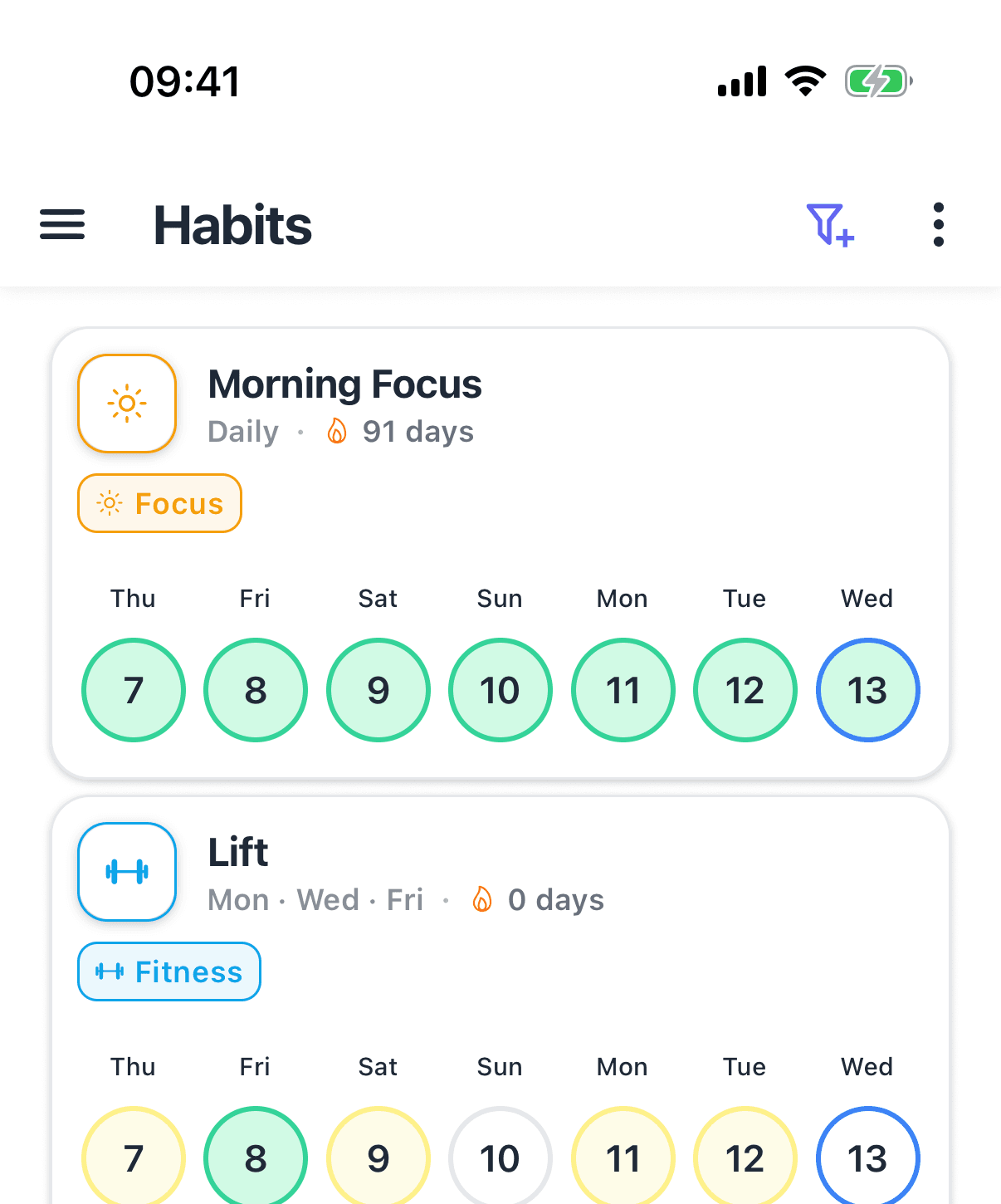
January resolutions fail on a technicality more often than a motivational one: the habit happens three times a week, but the tracker is configured for seven days. Four days a week now show up as misses, the completion rate looks like failure, and the tracker itself manufactures the quit-decision. Tuesday was never a scheduled gym day — a tracker that says otherwise is lying about your life.
Match the schedule to the behavior before January starts: specific weekdays for work-anchored habits, every-N-day rhythms for training, and flexible weekly targets ("3 times a week, any days") for everything that should happen but should not dictate which days. The gym consistency guide shows the training version, and the complete guide to habit tracking covers the full scheduling menu.
Failure mode 3: the slip becomes a spiral
Here is the most encouraging finding in the resolution literature: in Norcross's studies, successful resolvers slipped just as much in early January as unsuccessful resolvers. 71% of the successful group said their first slip actually strengthened their efforts. Everyone slips; the people who last treat a slip as information — refine the plan, resume tomorrow — rather than as evidence that the resolution is over. As the research put it: a lapse does not need to become a relapse.
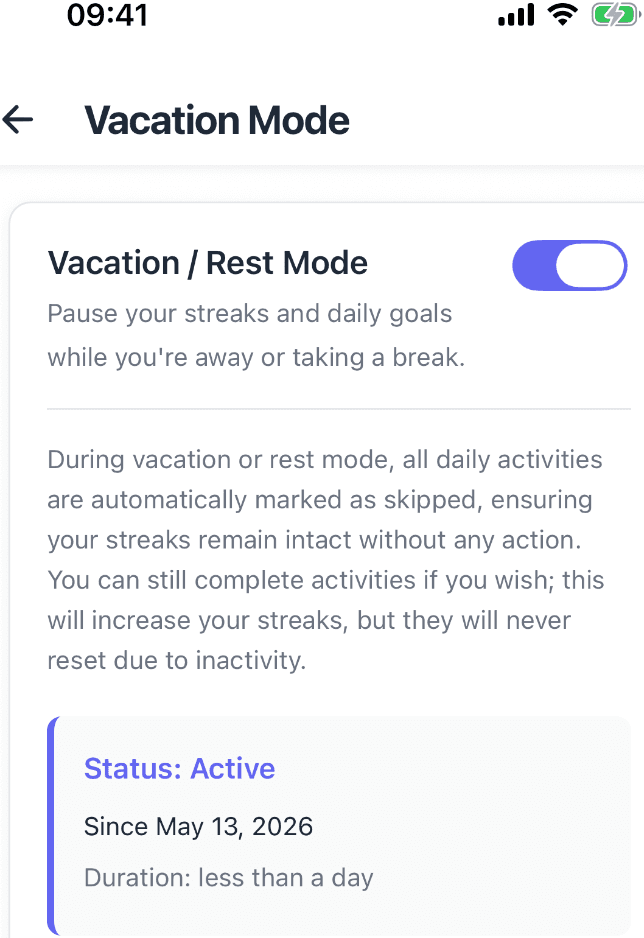
Your tracker should be built for that reality. A record that distinguishes done, skipped, and failed days lets you log the slip honestly without the app adding punishment on top — and planned breaks (a trip in February, a sick week) belong to vacation mode, not to a destroyed streak. Our guide to tracking without streak anxiety covers the psychology, and vacation mode covers the mechanics.
Failure mode 4: no review, no visibility
The resolution research has a clear pattern in who succeeds: Norcross found successful resolvers employed significantly more stimulus control and reinforcement than the unsuccessful. In plain terms: they arranged their environment so the habit was in front of them, and they made the progress feel rewarding.
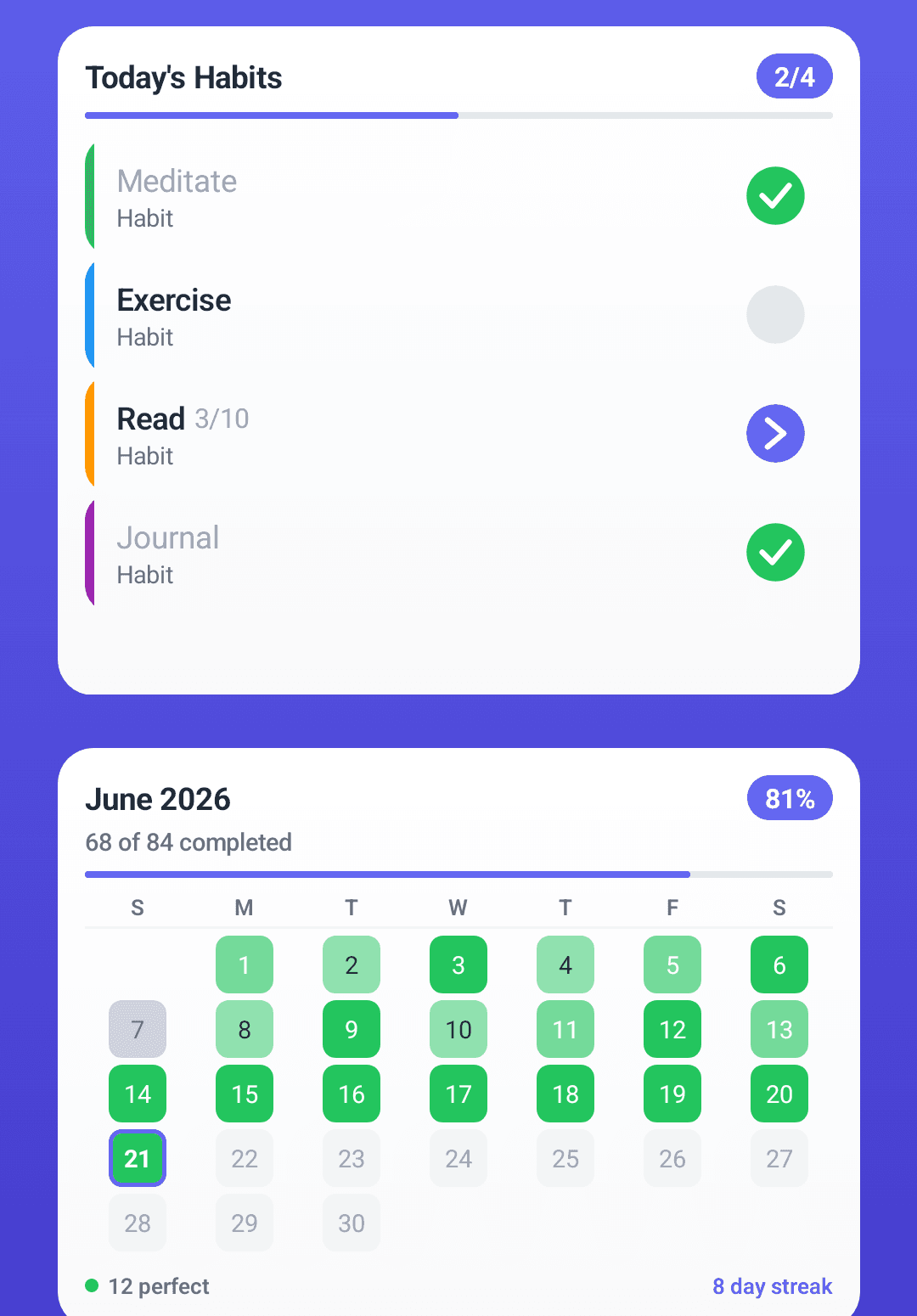
Translated into a tracking system, that is two habits of its own. First, visibility: the tracker lives where your eyes are — for paper, on the pillow; for apps, a home-screen widget that shows today's habits without opening anything (our widgets guide covers the layouts that help). Second, review: ten minutes each week to look at what happened, what got hard, and one variable to change. A record you never review is the quiet fade in slow motion.
Your January setup: the two-week plan
Do this before or during the first week — it takes one evening and ten minutes a week after:
- Pick 1–3 resolutions, phrased as specific, observable behaviors with a real threshold — not outcomes.
- Define done now, before January: the completion rule is decided when you set it up, not negotiated each night.
- Schedule real opportunities — match weekdays, intervals, or weekly targets to the behavior as it actually happens.
- Stack it onto an existing routine with a cue that occurs where and when the habit is possible.
- Put the tracker in sight — a widget on the home screen, or the journal on the pillow.
- Book the first two weekly reviews — ten minutes, three questions: what worked, what got hard, what one thing changes next week.
- Pre-decide the slip policy: a slip gets recorded honestly and resumed the next day — no make-up debt, no spirals. Never miss twice; one miss is an accident.
Choosing a tracker for resolutions (honestly)
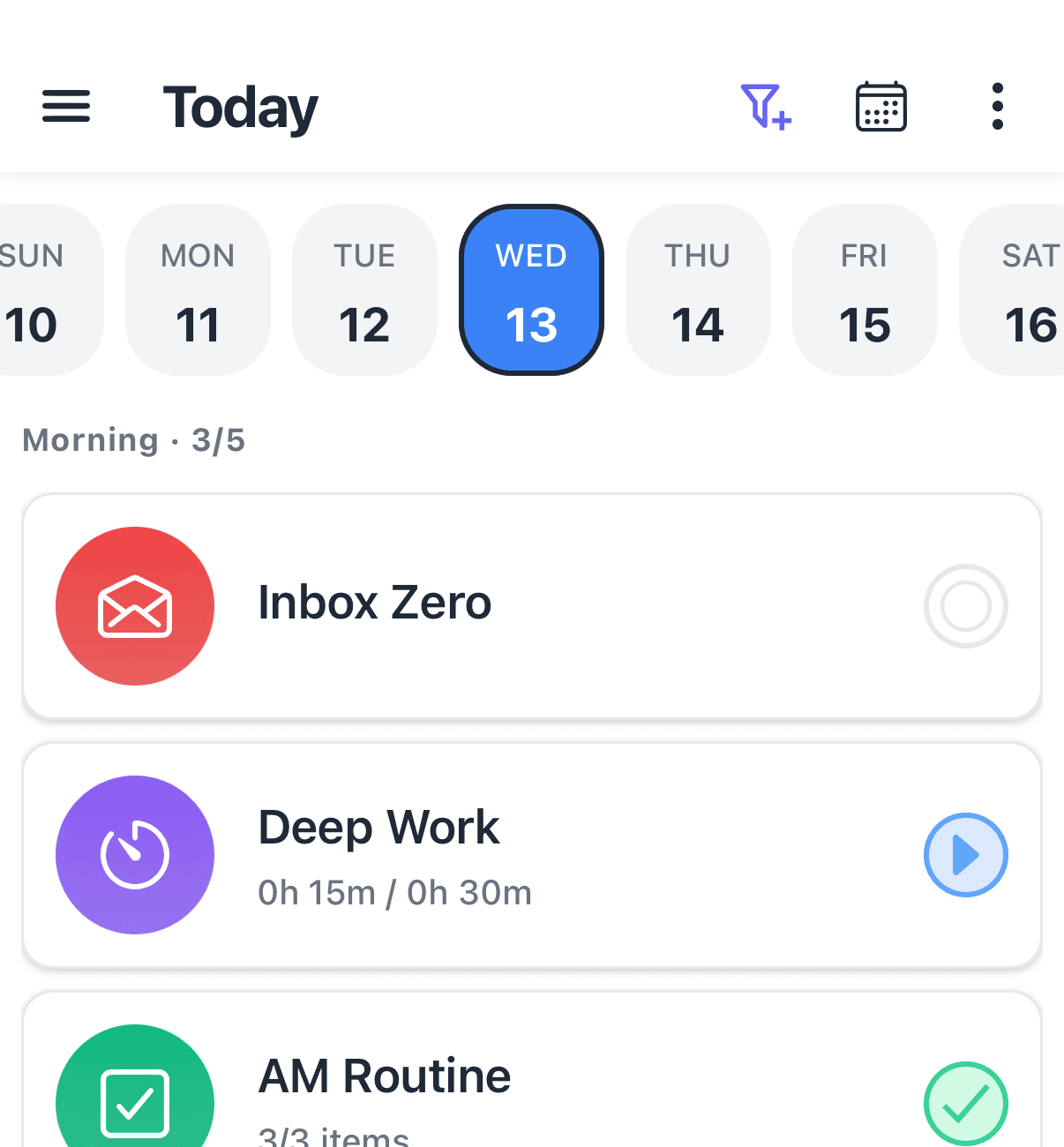
Whatever tool you choose, judge it on the failure modes above: honest records for skipped days, schedules that match reality, planned-break support, visibility, and data you control. We wrote an honest guide to the best free habit trackers — including what "free" usually hides — and head-to-head comparisons for Loop, Habitica, and Fabulous, so you can decide without taking our word for it. HabitGrip itself is on Google Play for Android — built precisely around this system.
One last note on timing: January 1 is a fine start date if you are ready. If you are not, the research says pick the day you actually are — the same system works starting February 1, or mid-June. And if a routine fell apart in the past and you are rebuilding it, the two-week restart plan applies the same mechanics to any comeback.
Frequently asked questions
What percentage of New Year's resolutions fail?
The honest numbers are more encouraging than the myths. In Norcross's longitudinal studies, 77% of resolvers were still successful after one week, and 40–46% were continuously successful at six months — versus 4% of comparable people who wanted change but made no resolution. Resolutions do degrade over time (19% maintained theirs for two years in the 1988 study), but a resolution plus a system beats not trying by an order of magnitude.
Do I have to start my resolution on January 1?
No. Norcross's research explicitly advises taking a resolution seriously or not at all — and people who push themselves into a resolution prematurely, without a specific action plan, are quite likely to fail. Pick a start date when you are actually ready, build the plan first, and use the calendar date only if it happens to be the day you are prepared.
I already slipped in January — is my resolution over?
Almost certainly not. In Norcross's research, successful resolvers slipped just as much in early January as unsuccessful ones — the difference was the response to the slip, not the absence of slips. 71% of successful resolvers said their first slip actually strengthened their efforts. A lapse does not need to become a relapse; record it honestly and continue the next day.
What's the best habit tracker for New Year's resolutions?
The one that handles resolution failure modes honestly: flexible schedules that match the behavior (so a 3x/week gym plan is not 'missed' four days a week), separate skipped/failed records instead of streak punishment, planned-break support, home-screen widgets for daily visibility, and data you control. Our honest guide to the best free habit trackers covers the landscape, and comparisons exist for Loop, Habitica, and Fabulous.
How many resolutions should I make?
One to three. Every resolution is really two commitments — the behavior and the tracking of the behavior — and stacking too many new commitments in January is the most reliable way to abandon all of them by February. Start with one to three, and add the next only once the current ones feel automatic (research suggests around 66 days on average).
Sources
- Norcross & Vangarelli (1988): The resolution solution — longitudinal examination of New Year's change attempts
- Norcross, Ratzin & Payne (1989): Ringing in the new year — change processes and reported outcomes of resolutions
- Norcross on NPR (2008): How to make New Year's resolutions stick
- Lally et al. (2010): How are habits formed — modelling habit formation in the real world
- BJ Fogg: Tiny Habits
- Moshontz & Hoyle (2022): Goal disengagement in everyday life — longitudinal observation of New Year's resolutions; data and study records available via the Open Science Framework (osf.io/t7bjc)
Make this the year the record stays honest
HabitGrip records done, skipped, and failed honestly, schedules to real life, and keeps offline tracking at the center.